
UMCG drafts replies to patient portal messages with GPT-4
University Medical Center Groningen built GPT-4 drafts into its Epic health record, so clinicians start from a suggested reply when patients write in through the mijnUMCG portal.
University Medical Center GroningenNetherlands (Groningen)Hospitals and health systemsScaled since 2023
- Scale
- About 8,000 patient messages a month (April 2026)
- Scenario
- Patient portal message reply drafting
- Business function
- Clinical care
- Kind of solution
- Document review and drafting
- Who built it
- Vendor product (Epic Systems Corporation and Microsoft)
- Where it runs
- Vendor-hosted service
- Human oversight
- Assists people
- Organization
- Public sector
- AI types
- Generative AI
- Users
- 100
tl;drClinicians started from the AI draft in 58% of 919 patient replies in a 16-week study.See the results
University Medical Center Groningen (UMCG) uses GPT-4 inside its Epic electronic health record (EHR) to draft replies to patients’ written questions1, 3. A clinician checks and edits each draft before it goes to the patient1.
UMCG and the Elisabeth-TweeSteden Hospital (ETZ) in Tilburg trialed the application in 20231. In November 2023, UMCG described itself as the first hospital in Europe to use it in written contact with patients2. By December 2024, the draft replies were available across the hospital4.
In a 16-week study in 2024, clinicians started from the AI draft in 58% of 919 replies to patient messages3. In April 2026, UMCG reported that large language models draft replies to the patient messages it receives each month5.
Before the deployment
Before the drafts, clinicians answered patients’ written questions in between other tasks, often between clinic visits because their schedules were full1, 4. Under that time pressure, replies were sometimes curt and showed little empathy1, 4.
- Weekly volume in 2023: Patients sent UMCG clinicians over 1,200 written questions a week1.
- Monthly volume: Doctors received more than 8,000 patient questions a month through the mijnUMCG portal by late 2024, and the hospital reported about 8,000 patient messages a month in April 20264, 5.
- Topics: The questions cover medication use, pain management, and when patients can return to sports, work or travel after surgery1.
- Workload: Answering the questions took a lot of time that doctors and other clinicians often didn’t have1.
UMCG adopted the drafts to reduce the administrative load on doctors, nurse specialists and other clinicians, so that they have more time for patients1.
What was built
The solution reads each incoming patient message, picks a prompt for the message’s category, and drafts a reply from the message and selected chart details3. The clinician sees the message and the draft together and decides what goes out3.
- Classification model: GPT-3.5 Turbo sorts each incoming message into a category, which decides what information from the chart the draft uses3, 2.
- Drafting model: GPT-4 reads the full question and drafts a reply to every part of it3, 4. It gives general medical information but no personal medical advice. For example, it can tell a patient that flying is normally allowed six weeks after ear surgery2.
- EHR: The Epic record builds each prompt from the category’s template and the patient’s chart. The application doesn’t learn from patient data, and the data stays inside the record, out of the vendor’s reach1, 3.
- Clinicians: They start from the draft or from a blank reply, then edit, rewrite or discard the draft. A link in the draft opens the relevant chart documents3, 4.
- Safeguard: The EHR doesn’t let a clinician send a draft without reviewing it, and the clinician stays responsible for every reply3, 4.
“Artificial intelligence can support and simplify the work, but healthcare professionals are irreplaceable in care for the time being.”
Rollout
The rollout took six months at UMCG, and the next hospital with the same EHR took about two months4. UMCG introduced the application in cooperation with other hospitals in the Epic Dutch user association1.
Technology and architecture
Epic developed the application, and UMCG runs it as part of its Epic EHR1. A team of medical and technical experts from several hospitals wrote and refined the category prompts3.
| Layer | What they used | Role | Source |
|---|---|---|---|
| Customer app or website | mijnUMCG patient portal | Where patients send written questions to their clinicians | 4 |
| Language model | GPT-3.5 Turbo | Classifies each message as general, results, medications or paperwork | 3 |
| Prompt and context management | Category prompts | One prompt per category, with instructions, the message and chart details, fixed at deployment | 2, 3 |
| Language model | GPT-4 | Drafts the reply at temperature 0, for reproducibility | 3 |
| Model hosting | Azure OpenAI Service | Runs the models that the EHR calls | 3 |
| Business or operational system | Epic electronic health record | Holds the chart, builds the prompts and keeps patient data inside the record | 1, 3, 5 |
| Review workbench | Reply screen in the EHR | Shows the message and the draft, with a choice of draft or blank reply | 3 |
Data inputs
- Patient messages: The written question, with the category that the patient selects before sending it3.
- Chart details: Name, age, allergies, medication list and future appointments. Each category sets what the prompt includes, such as recent operations or the full operation report3, 2.
- Historical patient messages: At least 20 messages per category, used to test each version of the prompts3.
- Audit logs: Timestamps from the EHR, used to measure reading, drafting and total response times3.
Integrations
- Epic EHR: The drafting runs inside the record, which adds chart details to the prompt and shows the draft to the clinician1, 3.
- Azure OpenAI Service: Epic manages all model calls under existing contracts. Data is encrypted in transit, and human review by third parties such as Microsoft is disabled3.
- mijnUMCG: Patients reach their clinicians through the mijnUMCG environment4.
How one patient message flows through the system
- The patient writes a question in mijnUMCG and selects a category before sending it3, 4.
- GPT-3.5 Turbo classifies the message as general, results, medications or paperwork. Epic chose these four categories3.
- The EHR fills the category’s prompt with its instructions, the message and the chart details that the category needs3, 2.
- GPT-4 drafts a reply that answers each part of the question3, 4.
- The clinician opens the message and the draft, and starts from the draft or from a blank reply3.
- The clinician checks the chart documents through the link if needed, edits the reply and sends it4.
Results
| Metric | Before | After | Scope and timeframe | Reported by |
|---|---|---|---|---|
| Replies started from the AI draft | Not disclosed | 58% | 919 replies by 100 physicians, March 1 to June 19, 2024 | UMCG researchers, measured3 |
| Draft-started replies that kept a large part of the draft | Not disclosed | 43% | 529 replies started from the draft, same study | UMCG researchers, measured3 |
| Median total response time | 157 seconds, blank reply | 153 seconds, draft kept in large part | Same study, difference not significant | UMCG researchers, measured3 |
| Median length of the sent reply | 34 words, blank reply | 54 words, draft kept in large part | Same study | UMCG researchers, measured3 |
- Replies started from the draft: Clinicians in 14 specialties chose between the draft and a blank reply for each message. The share counts replies that began from the draft3.
- Draft kept in large part: A reply counts when more than 10% of its words match the draft. In those replies, 86% of the draft’s words reached the patient, against 16% overlap for blank replies3.
- Total response time: This runs from the clinician’s last view of the message to sending. Drafting took 74 seconds with the draft against 88 seconds for a blank reply, and reading before acting took 53 seconds against 343.
- Reply length: Replies built on the draft were about 60% longer than replies written from scratch3.
Lessons learned
Most replies started from the draft, and the deployment grew from a two-hospital trial to the whole hospital3, 4. Translation problems in the Dutch setting were smaller than the team expected, and the prompt work corrected the errors that did occur3.
The drafts didn’t save time. Shorter drafting was offset by longer reading before the clinician acted, and the authors expect a learning curve3. UC San Diego Health found the same in its own study of Epic drafts6.
Use of the drafts varied widely between medical specialties, and every specialty used the same prompts3. The authors recommend specialty-specific prompts and fine-tuned healthcare models to raise adoption, in place of the generic foundation model used3.
The rule against medical advice limits what the drafts can say. UMCG instructed the model not to give medical advice to comply with the European Medical Device Regulation, and the authors judge that this might have lowered draft quality, because patients’ questions are often medical3.
Onboarding came before access, because clinicians stay responsible for each reply. Bart Scheerder of the UMCG Innovation Center said clinicians need to understand both what the technology can do and its shortcomings4. Sharing these implementation lessons with other hospitals sped up the next rollout4.
The results come from a peer-reviewed study by UMCG’s own clinicians and researchers, and the message volumes are the hospital’s own figures3, 5.
Case study scorecard
- 58% Replies that clinicians started from the AI draft3
- 43% Draft-started replies that kept a large part of the draft3
- 153 seconds Median total response time with a draft kept in large part3
- Source quality: 82%, High quality. Rests on a peer-reviewed paper.
- Rules and standards: Medical device rules
Sources by publication date
- Organization 2
- Press, academic, and regulators 4
Build this solution yourself
Analysis
What you need
- An EHR that runs the drafting inside the record: UMCG adopted Epic’s application, which builds each draft from chart data and keeps that data in the record1, 3. You need the same, because the prompt draws on the chart and the reply is sent from the record.
- A team that writes and tests prompts in your language: UMCG’s multicenter team tested each prompt version on historical Dutch messages before it fixed the prompts3.
- Onboarding for every clinician: Access followed a mandatory e-learning, because the clinician who sends a reply answers for it3, 4.
Reference architecture
Document review and drafting
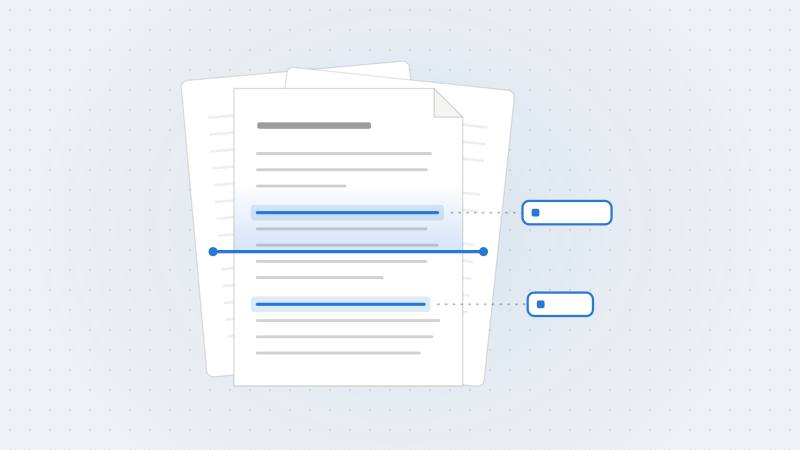
A document review and drafting solution reads a case's documents against a written standard, precedents, or a list of questions and drafts a review, summary, clause, or report with its sources for an expert to finish. The solution pulls the case's documents, and a language model answers each question from the passages that bear on it, with its source. Fixed logic settles what must not vary, and an expert checks the draft against the sources and makes the decision.
- Source system (documented in this case study)
- Connector to the source system
- Review and drafting platform
- Text recognition
- Document preparation
- Passage index
- Access control
- Questions and templates (documented in this case study)
- Drafting model (documented in this case study)
- Private model endpoint (documented in this case study)
- Fixed logic
- Review workbench (documented in this case study)
- Reviewer feedback
- Tests on known cases
A check mark shows a building block that this case study's sources document.
Open the reference architectureOthers who built it
In the library
- How Nationwide uses generative AI to summarize claim notes Nationwide
- Merck drafts clinical study reports in days with gen AI Merck & Co.
- AI drafts clinical study reports in minutes at Novo Nordisk Novo Nordisk
- Corona, California speeds building plan review with AI City of Corona
- Denver pre-screens permit applications with CivCheck AI City and County of Denver
- Court strikes down DOGE's ChatGPT screening of NEH grants United States DOGE Service
Cite this case study
Enterprise AI Case Studies. "UMCG drafts replies to patient portal messages with GPT-4." Updated Nov 21, 2026. https://case-studies.ai/case-studies/customer-engagement/CE-049-patient-message-reply-drafting-umcg/
@misc{csai-ce-049,
  author = {{Enterprise AI Case Studies}},
  title = {{UMCG drafts replies to patient portal messages with GPT-4}},
  year = {2026},
  note = {Updated 2026-11-21},
  url = {https://case-studies.ai/case-studies/customer-engagement/CE-049-patient-message-reply-drafting-umcg/}
}Sources
The following reporting, and every passage quoted from it, belongs to its publisher, not to this site. Sources and ownership
- Source 1:
UMCG answers patients' questions with the help of AI
Supporting excerpts (15)
An AI application in the electronic patient record (EPR) reads the patient's question and suggests a response. The healthcare provider receives the AI-generated draft answer, reviews it, and adjusts it as necessary.
The expectation is that it can significantly reduce the administrative burden on doctors, nurse specialists, and other healthcare professionals.
In recent months, the UMCG and the ETZ in Tilburg conducted a trial with this AI application.
The UMCG is the first hospital in Europe to actually implement the chatbot in written communication with patients.
During the trial period, healthcare providers meticulously checked the AI-generated responses.
Artificial intelligence can support and simplify the work, but healthcare professionals are irreplaceable in care for the time being.
Weekly, patients ask over 1200 written questions to their UMCG healthcare provider.
These questions may relate to medication use, pain management, and when they can resume activities like sports, work, or travel after surgery.
Answering all these questions consumes a lot of time for doctors and other healthcare providers
if healthcare providers spend less time on these administrative tasks, there is more time for the patient
The AI application was developed by EPR provider Epic.
the chatbot does not learn from patient data
The chatbot is integrated into the EPR, ensuring patient data remains secure within the system. Even the vendor cannot access it.
This collaboration is part of the EPIC Dutch Association, involving cooperation with other hospitals.
Because healthcare providers now answer questions in between other tasks, they often do so somewhat abruptly.
- Source 2:
AI beantwoordt vragen patiënten Groningen: 'Informatiever en empathischer'
Supporting excerpts (6)
Het ziekenhuis is naar eigen zeggen het eerste in Europa dat kunstmatige intelligentie (AI) op deze manier inzet.
Het systeem bepaalt eerst in welke categorie de vraag past
Per categorie is bepaald naar welke informatie het systeem kijkt. We kunnen bijvoorbeeld bepalen dat het recente operaties meeneemt, of zelfs het hele operatieverslag.
Persoonlijk medisch advies geven mag niet, maar wel algemene medische informatie.
Als een patiënt na een ooroperatie wil weten of hij alweer mag vliegen, kan de robot antwoorden dat dit normaal gesproken na zes weken mag.
Reden daarvoor is privacy: de robot is geïntegreerd in het elektronisch patiëntendossier en de gegevens blijven daarbinnen.
- Source 3:
AI-generated draft replies to patient messages: exploring effects of implementation
Supporting excerpts (37)
A total of 919 messages by 100 physicians were evaluated. Clinicians used the LLM draft in 58% of replies.
Of these, 43% used a large part of the suggested text for the final answer (≥10% match drafted responses: ROUGE-1: 86% similarity, vs. blank replies: ROUGE-1: 16%).
Total response time did not significantly different when using a blank reply compared to using a drafted reply with ≥10% match (157 vs. 153 s, p = 0.69).
General adoption of LLM-generated draft responses to patient messages was 58%, although the level of adjustments on the drafted message varied widely between medical specialties.
The current implementation has not yet resulted in time savings, but a learning curve can be expected.
all clinicians from 14 medical specialties of a large Dutch academic hospital were invited to use the LLM-generated draft replies after completing a mandatory e-learning.
The study period lasted 16 weeks (March 1 to June 19, 2024).
LLM-generated draft responses to patient messages were generated using Microsoft's Azure Open AI through the EHR (Epic Systems Corporation, Verona, WI, USA).
Incoming messages were automatically classified by the GPT-3.5 Turbo model into four categories (general, results, medications, and paperwork), based the contents of the message (Figure 1).
These categories were chosen by our EHR provider Epic. The patient makes the choice by selecting the most appropriate category before sending the message.
Each category had a different corresponding prompt, which included specific instructions, the patient message, and selected relevant information from the patient chart (e.g., name, age, allergies, medication list, future appointments, etc.).
the GPT-4 model was subsequently used to draft a response to the patient's message with a temperature setting of 0 for reproducibility purposes.
Within the EHR, the clinician viewed both the patient message and the draft reply and was presented with the option to start with the draft or a blank reply.
The clinician was not able to send the LLM-generated draft message immediately to the patient. This was done to ensure for safety.
Prompt engineering (the act of writing sound instructions to the LLM) was performed by a team of multicenter medical and technical experts in an iterative manner
Each iteration of the prompts was tested on at least 20 historical patient messages for each category.
Clinicians that are part of the hospital's AI team provided feedback on correctness, harmfulness and usefulness to prompt engineering team.
After 3–6 iterations, depending on the category
An independent group of six physicians then extensively tested the functionality with the final for reliability during a 3-months pilot phase in an electronic dummy environment
The prompts were then fixed at deployment. The clinicians did not have access to the prompts. The same prompts of each category were used for all clinicians, regardless of medical specialty.
These time intervals were measured using audit-log data.
the validated ROUGE-1 and BLEU-1 scores for analysis of computational linguistics and natural language processing were used
All LLM interactions are managed by the EHR vendor under existing strict contractual agreements. Human review by third parties, such as Microsoft, is disabled. All patient-sensitive data are encrypted in transit to and from the LLM.
does not fall within the scope of the Medical Device Regulation as it is not intended for a medical purpose and does not provide clinical decision support.
Finally, due to compliance with the European Medical Device Regulation, we specifically instructed the model not to provide any medical advice.
this decision could have significantly affected the quality of the initial LLM-generated draft response from the clinician's perspective, thereby limiting the use of this technology in clinical practice.
Third, we used a generic foundation model instead of a fine-tuned healthcare-specific model that was uniquely trained to draft responses to patient questions.
We recommend exploring specialty-specific prompts and fine-tuned healthcare-specific models to enhance adoption and usefulness.
However, the total time savings are offset by increased read times
Read-to-action time was faster for users starting a blank reply (34 vs. 53 s, p < 0.001), whereas patient draft time was longer compared to clinicians using drafted replies with ≥10% match (88 vs. 74 s, p = 0.023).
In our study, LLM-assisted replies were approximately 60% longer than blank replies (54 vs. 34 words)
When we began this study, we anticipated translation issues due to the Dutch-speaking environment. However, the problem was less significant than expected.
were easily corrected during the prompting phase
There was a large variation in the adoption of the LLM-drafted responses between medical specialties (Table 3).
When the draft responses were used, 43% (n = 227) used more than 10% of the suggested text in their final response.
Clinicians chose to use the drafted response as a template for the sent answer in 58% of the cases (n = 529), and 42% (n = 390) used a blank reply (Figure 2).
because patients are informed in case of the use of AI. Messages were never send without the approval of the physician.
- Source 4:
'Het is logisch dat we hiermee als UMC voorop lopen'
Supporting excerpts (12)
meer dan achtduizend vragen van patiënten op hun bord
-omgeving van het ziekenhuis meer dan achtduizend vragen van patiënten op hun bord
vaak tussen verschillende polibezoeken door worden beantwoord
Want de antwoorden zijn door tijdgebrek soms staccato en weinig empathisch.
is inmiddels voor het hele ziekenhuis beschikbaar
Voor dit antwoord krijgt het algoritme relevante dossierstukken van de patiënt, onder de juiste veiligheids- en privacy-voorwaarden.
Het taalmodel analyseert de volledige vraag en formuleert een reactie op alle onderdelen van die vraag.
Het antwoord wordt altijd gecheckt door de arts, die – waar nodig – via een link in het antwoord nog de juiste dossierstukken erop na kan slaan.
Maar zij of hij kan er ook voor kiezen om het voorbereide antwoord aan te passen of helemaal weg te gooien en zelf iets te schrijven.
krijgen ze eerst een onboarding. Want zij zijn uiteindelijk nog steeds verantwoordelijk voor de reactie die ze versturen.
Het is belangrijk om te begrijpen wat deze technologie kan, maar ook wat de tekortkomingen zijn.
De casus van de conceptantwoorden rolden we bij UMCG in zes maanden uit. Bij een volgend ziekenhuis met hetzelfde EPD lukte dat veel sneller, naar ik meen zelfs in twee maanden tijd!
- Source 5:
De Titanic van de zorg: UMCG zet in op autonome systemen
Supporting excerpts (4)
lid van de Raad van Bestuur van het Universitair Medisch Centrum Groningen (UMCG)
Om dat te realiseren werkt het ziekenhuis samen met Epic
Samen integreren ze AI direct in de medische workflow.
8.000 patiëntberichten. Met behulp van large language models genereert AI nu automatisch conceptantwoorden
- Source 6:
Study Reveals AI Enhances Physician-Patient Communication
Supporting excerpts (2)
Using generative AI to draft patient responses to non-emergency questions has been tested in the pilot program with electronic health record vendor Epic Systems, initiated in April 2023 at UC San Diego Health
although AI-generated replies did not reduce physician response time





Comments
Start the conversation.
Invited members of the library comment here. Sign in to join the conversation.