
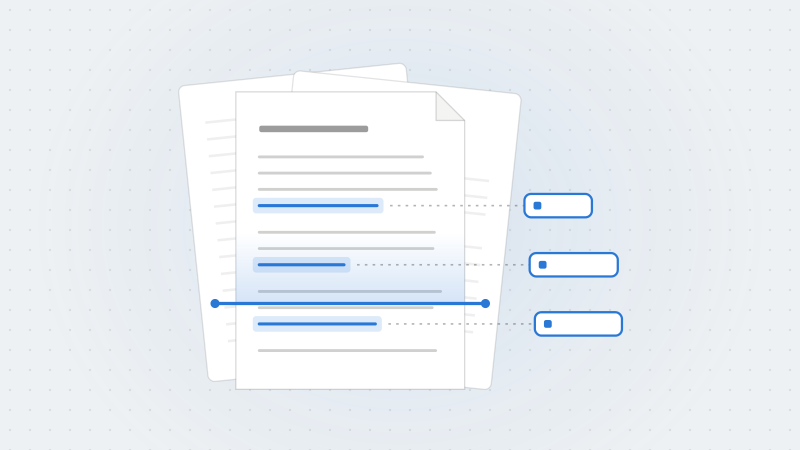
Selective's AI claims ingestion tool tops 500,000 documents
Selective Insurance Group put an AI claims ingestion tool to work on the documents that arrive with its claims, so that its adjusters can spend their time on higher-value work.
Selective Insurance GroupUnited StatesProperty and casualty insuranceIn production
- Scale
- More than 500,000 claim documents processed
- Scenario
- Insurance claims document ingestion
- Business function
- Customer service
- Kind of solution
- Document extraction
- Organization
- Enterprise, 1,000 to 9,999 employees
- AI types
- Document AI
tl;drSelective's AI claims ingestion tool has processed more than 500,000 claim documents.See the results
Selective Insurance Group uses an AI claims ingestion tool to process the documents that come in on its claims1. Selective is a New Jersey insurance holding company that sells property and casualty insurance through independent agents and wholesale brokers5.
By April 2026, the tool had processed more than 500,000 documents, a figure given on Selective’s first-quarter earnings call1. The tool lets adjusters focus on higher-value work1. In October 2026, Selective’s third-quarter investor presentation still listed AI claims tools among its operational enhancements3.
Before the deployment
Selective’s claims organization works by line of business and by the complexity of the loss5. It is organized as follows:
- Technical areas: Adjusters handle claims by area of expertise, such as automobile liability, general liability, property, and workers compensation5.
- Specialized units: Each business line has a unit for high-severity or technically complex losses and litigation5.
- High-volume claims: Dedicated adjusters manage high-volume, low-severity automobile and property claims with virtual adjusting tools5.
- New claims system: In 2025, Selective implemented a modernized claims system for its commercial automobile, personal automobile, general liability, and commercial property lines5.
The company had about 2,800 employees at the end of 20255. Its April 2026 investor presentation set claim system modernization among its strategic investments, under a heading on balancing expense discipline with those investments2. A significant portion of its 2026 technology investment goes to risk selection, pricing accuracy, and productivity1.
What was built
The AI claims ingestion tool processes the documents that arrive on claims, so that adjusters can focus on higher-value work1. The work is divided as follows:
- AI claims ingestion tool: Processes incoming claim documents. It had processed more than 500,000 by April 20261.
- Adjusters: Focus on the higher-value work of the claim. Selective’s AI tools run with a focus on human-in-the-loop engagement for AI outputs1.
- AI and Model Governance Committee: A cross-disciplinary committee, accountable to the Executive Risk Committee, governs how internal and external models are acquired, built, deployed, and used1, 5.
Marchioni presented the tool as one of two AI tools that stand out among many Selective has deployed1.
“While we have deployed many AI tools and are evaluating more, I would like to highlight two that are having a meaningful impact in driving better, more consistent outcomes, while also improving productivity.”
The second tool works in underwriting. It automates support for evaluating contractual risk transfer adequacy, which Marchioni called a key element of underwriting contractors1. Contractors are one of five strategic business units in Selective’s Standard Commercial Lines5.
Rollout
Selective’s AI claims work developed as follows:
- February 2026: The 2025 annual report describes growing use of general-purpose and industry-trained generative AI that uses large language models5.
- April 2026: The first-quarter investor presentation lists the AI claims ingestion tool and the automation of contractual risk transfers as operational enhancements2. The next day, Marchioni gave the 500,000-document figure1.
- October 2026: The third-quarter presentation lists AI claims tools beside the contractual risk transfer automation3. The quarterly report names general-purpose, industry-trained, and agentic AI solutions in Selective’s strategy4.
Technology and architecture
The AI claims ingestion tool is an AI application for claim documents1, 2. In this deployment, it processes the documents that come in on claims, and its outputs go to people under the human-in-the-loop approach1. The following table lists the component of the solution.
| Layer | What they used | Role | Source |
|---|---|---|---|
| Solution platform | AI claims ingestion tool | Processes incoming claim documents so that adjusters can focus on higher-value work | 1, 2 |
The tool’s input is the documents that come in on claims1.
Results
The tool had processed more than 500,000 documents by April 23, 20261. The following table lists the result.
| Metric | Before | After | Scope and timeframe | Reported by |
|---|---|---|---|---|
| Documents processed by the AI claims ingestion tool | Not disclosed | More than 500,000 | Running total, stated on the first-quarter 2026 earnings call | Selective, measured1 |
The following points explain the results:
- Documents processed: The figure counts the claim documents the tool has processed, as a running total on April 23, 20261.
- Adjusters’ work: The tool lets adjusters focus on higher-value work1.
- Contractual risk transfer tool: The separate underwriting tool returns over 90% of its results within two minutes1.
- AI tools as a group: In October 2026, Selective described early AI successes in claims, underwriting, and risk management as delivering measurable outcomes in accuracy, speed, and productivity4.
Lessons learned
The tool runs at volume. More than 500,000 documents is a production count, stated to analysts on an earnings call, and Selective still listed AI claims tools two quarters later1, 3.
The figures are Selective’s own, from its chief executive’s prepared remarks on the April 2026 call and from its filings1, 4.
The 500,000 figure measures throughput. Selective states the benefit for adjusters in words: the tool lets them focus on higher-value work1.
Selective pairs its AI tools with governance. Marchioni tied the cross-disciplinary committee and human-in-the-loop engagement to accuracy, quality, and trust as the company scales AI1. The committee answers to the Executive Risk Committee and covers internal and external models alike5.
Case study scorecard
- More than 500,000 Claim documents processed by the AI claims ingestion tool1
Sources by publication date
- Organization 6
- Press, academic, and regulators 1
Build this solution yourself
Analysis
What you need
To build this solution, you need the following in place:
- Adjusters organized by line and complexity: Selective’s adjusters work by technical area, with units for complex losses, so time freed from documents goes to the higher-value work the tool is meant to release1, 5.
- A model governance body that covers AI tools: Selective runs its tools under a committee accountable to its Executive Risk Committee and with human-in-the-loop engagement for AI outputs, which it ties to accuracy and trust1, 5.
- A modern claims system: Selective implemented one for four lines in 20255.
Reference architecture
Document extraction
Document extraction reads the documents, forms, and images that an organization receives, sorts each one to its case, and turns it into structured fields for the business system that acts on it. Models read each document into fields, and ordinary software checks the fields against business rules and the organization's reference records. A reviewer compares the fields with the source before they reach the business system, or sees only the doubtful ones, and the corrections measure and improve the models.
- Document intake
- Document extraction platform (documented in this case study)
- Preparation
- Text recognition
- Extraction model
- Validation rules
- Reference records
- Workflow engine
- Review workbench
- Answer explanation
- Connectors
- Business system
- Corrections log
- Accuracy monitoring
A check mark shows a building block that this case study's sources document.
Open the reference architectureOthers who built it
- Allianz: Project Nemo, launched in Australia in July 2025, uses AI agents to check food spoilage claims and passes a summary of their decisions to a person, who decides on payment6.
- Aviva: An underwriting tool uses generative AI to analyze and summarize GP medical reports, which are sometimes over 90 pages7.
In the library
- Condé Nast speeds rights contract analysis with Claude Condé Nast
- Cargolux drafts cargo quotes from customer emails with AI Cargolux Airlines International
- Air France KLM Martinair Cargo uses AI to book and quote Air France KLM Martinair Cargo
- Pennsylvania's AI check cuts illegible benefit documents Pennsylvania Department of Human Services
- How Liberty Global matches supplier invoices with GenAI Liberty Global
- Parte embeds AI in property managers' email in 27 offices Parte
Cite this case study
Enterprise AI Case Studies. "Selective's AI claims ingestion tool tops 500,000 documents." Updated Nov 18, 2026. https://case-studies.ai/case-studies/document-intelligence/DI-020-claims-document-ingestion-selective/
@misc{csai-di-020,
  author = {{Enterprise AI Case Studies}},
  title = {{Selective's AI claims ingestion tool tops 500,000 documents}},
  year = {2026},
  note = {Updated 2026-11-18},
  url = {https://case-studies.ai/case-studies/document-intelligence/DI-020-claims-document-ingestion-selective/}
}Sources
The following reporting, and every passage quoted from it, belongs to its publisher, not to this site. Sources and ownership
- Source 1:
Selective Insurance Group Q1 2026 earnings call
Supporting excerpts (9)
Call date April 23, 2026
Chairman, President, and CEO, Selective Insurance Group
A significant portion of our strategic technology investments in 2026 is focused on improving risk selection, pricing accuracy, and productivity.
While we have deployed many AI tools and are evaluating more, I would like to highlight two that are having a meaningful impact in driving better, more consistent outcomes, while also improving productivity.
Our AI claims ingestion tool has processed more than 500,000 documents, letting our adjusters focus on higher value work.
We also have deployed automation to support evaluation of contractual risk transfer adequacy, a key element of the underwriting process for contractors.
With over 90% of results returned by the tool within two minutes.
These tools are supported by a governance program with a cross-disciplinary AI and model governance committee and a focus on human-in-the-loop engagement for AI outputs.
These safeguards help us drive accuracy, quality, and trust as we scale AI responsibly across the enterprise.
- Source 2:
Selective Insurance Group first quarter 2026 investor presentation (Exhibit 99.3)
Supporting excerpts (5)
BALANCING EXPENSE DISCIPLINE WITH STRATEGIC INVESTMENTS
Claim system modernization
Further leveraging our use of data, analytics, and technology, including artificial intelligence
AI claims ingestion tool
Automation of Contractual Risk Transfers
- Source 3:
Selective Insurance Group third quarter 2026 investor presentation (Exhibit 99.3)
Supporting excerpts (2)
AI claims tools • Automation of Contractual Risk Transfers
Automation of Contractual Risk Transfers
- Source 4:
Selective Insurance Group Form 10-Q for the quarter ended September 30, 2026
Supporting excerpts (2)
including general-purpose, industry-trained, and agentic artificial intelligence
Early AI successes in claims, underwriting, and risk management are delivering measurable outcomes in accuracy, speed, and productivity, positioning us to responsibly scale AI across the organization.
- Source 5:
Selective Insurance Group Form 10-K for the year ended December 31, 2025
Supporting excerpts (12)
is a New Jersey insurance holding company incorporated in 1977
It owns ten property and casualty insurance subsidiaries
exclusively through independent insurance agents and wholesale brokers
We are increasingly leveraging general-purpose and industry-trained generative AI solutions that use large language models to improve internal process efficiency and effectiveness.
We maintain a cross-disciplinary Artificial Intelligence and Model Governance Committee, accountable to the Executive Risk Committee
to govern the acquisition, creation, deployment, use, and reliance on internal and external models in the execution of insurance activities
Claims handling by technical areas of expertise, such as automobile liability, general liability, property, and workers compensation, with a specialized claims unit for each business line focused on high-severity or technically complex losses and litigation.
Dedicated adjusters manage our high volume, low severity automobile and property claims, leveraging virtual adjusting tools
In 2025, we implemented a new, modernized claims system for our commercial automobile, personal automobile, general liability, and commercial property lines of business.
As of December 31, 2025, we had approximately 2,800 employees
We categorize our Standard Commercial Lines customers into five strategic business units
General contractors and trade contractors
- Source 6:
Allianz launched its first agentic AI to automate claims
Supporting excerpts (4)
Launched in Australia in July 2025, Nemo uses AI agents to automate low-complexity, repetitive tasks, significantly reducing processing times.
Allianz has launched its first agentic AI solution to automate food spoilage claims
writes up the summary of all the AI agents
passes it to a human agent to make the payment decision
- Source 7:
Aviva launches AI underwriting tool
Supporting excerpts (2)
using generative AI to analyse and summarise GP medical reports
which are sometimes over 90 pages














Comments
Start the conversation.
Invited members of the library comment here. Sign in to join the conversation.